
Mirror therapy: how to naturally relieve your neuropathic pain

Can a simple mirror fool your brain and soothe your pain? Mirror therapy uses this fascinating visual illusion to relieve neuropathic pain. Created in the 1990s, this non-drug technique exploits brain plasticity by manipulating what you see to change what you feel.
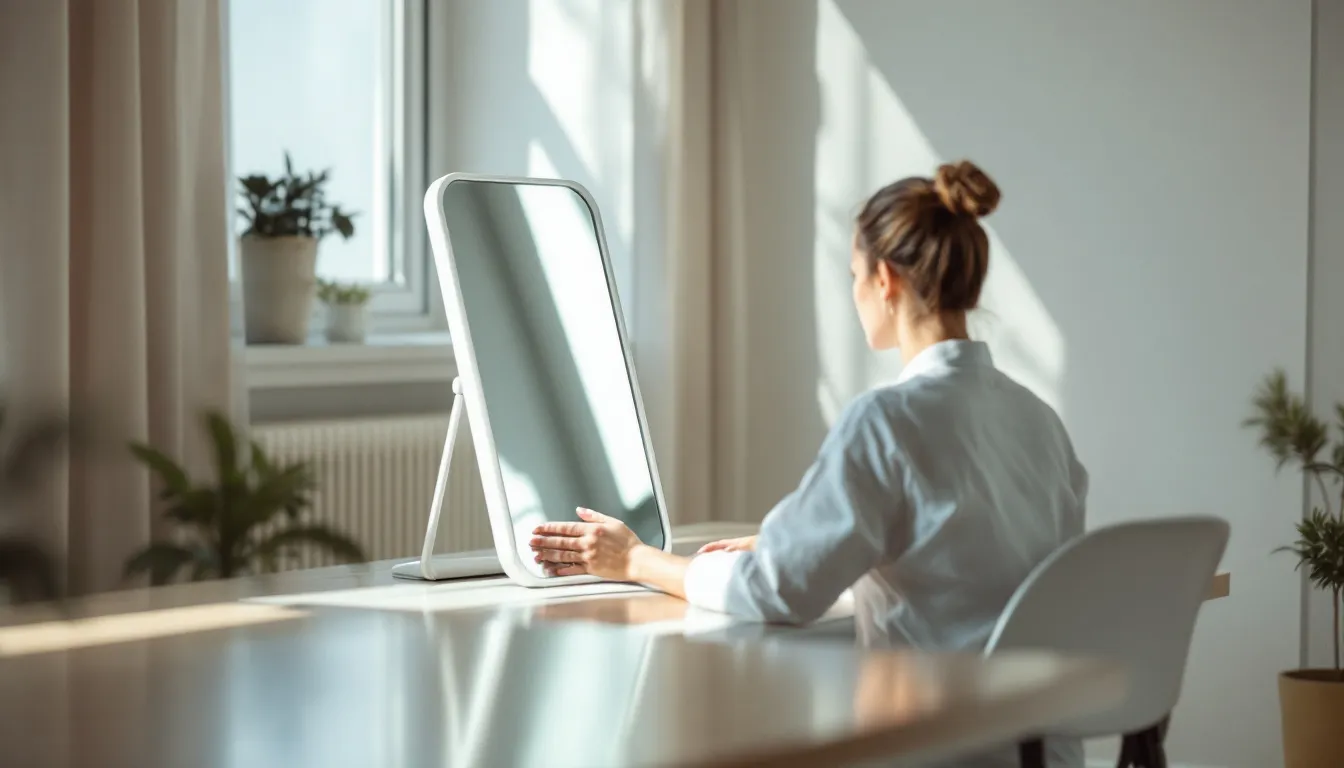
What is mirror therapy against neuropathic pain?
Pain changes when the eye tricks the brain. Here is how mirror therapy transforms this reality.
An innovative technique inspired by neuroscience
Mirror therapy was born in the 1990s thanks to neuroscientist Vilayanur Ramachandran. Its principle? A simple mirror placed between the healthy limb and the affected limb creates a fascinating visual illusion. Your brain sees the reflection of the healthy limb and believes that the injured limb is moving normally. This visual trick is not magic but applied neuroscience!
I discovered that this approach ingeniously uses our brain plasticity, somewhat like autosuggestion. The brain, easily influenced by visual information, lets itself be “tricked” by this illusion. This visual manipulation modifies neural circuits related to pain. Do you find that amazing? Yet it is the basis of this non-drug therapy that is gaining popularity.
Use for the treatment of phantom pain and brachial plexus paralysis
Two types of suffering respond particularly well to this approach. Phantom pain after amputation torments many patients. How to relieve pain in a limb that no longer exists? Mirror therapy provides an answer.
Brachial plexus paralysis is the other major indication. These nerve lesions, often caused by accidents, severely limit arm mobility. I have found that mirror therapy offers a valuable alternative when conventional treatments fail. It reorganizes brain maps to reduce painful perception. Have you ever imagined that a simple mirror could ease pain resistant to medication?
How does a mirror therapy session take place?
Simplicity often hides effectiveness. Let’s discover together the concrete déroulement of a session.
Standard duration and frequency
A typical session lasts between 15 and 20 minutes. Short but intense! To obtain results, regularity matters more than duration. The standard protocol recommends 5 weekly sessions for one to two months.
Recent approaches have evolved towards more autonomy. After a first session with a physiotherapist, you can often continue at home. I always encourage this daily practice which strengthens the effectiveness of treatment. Your brain needs this repetition to rewire its pain circuits.
Calm environment and absence of distractions
Calm is not optional but essential. Your concentration determines the effectiveness of mirror therapy. Turn off your phone, choose a quiet room, eliminate all visual or sound distractions.
This bubble of concentration allows your brain to fully focus on the created illusion. I have noticed that patients obtain better results in a serene environment. Think of it as a guided meditation for your nervous system. Your full attention amplifies the therapeutic effect.
Performing asymmetrical motor exercises
The heart of the session relies on precise and intentional movements. You place your healthy limb in front of the mirror and perform simple gestures while fixing its reflection. What do you see? The illusion that your affected limb moves normally.
The exercises are adapted to each patient by a rehabilitation professional:
- Gentle finger or wrist flexions and extensions
- Light joint rotations
- Functional movements such as grasping an object
- Progressive sequences adapted to your evolution
I insist on the importance of following your therapist’s recommendations. These movements seem simple but their neurological impact is profound. The mirror becomes the gateway to a new bodily perception.
Mirror therapy in virtual reality
Technological innovation is revolutionizing this therapy. The limits of the classic mirror are fading.
Advantages compared to classic therapy
Virtual reality propels mirror therapy towards new horizons. Gone are the constraints of the physical mirror! Tattoos, scars, or jewelry no longer disrupt the illusion. Immersion becomes total.
I tested these devices and was impressed by their ability to capture complex movements. Your healthy limb serves as the model to virtually animate the affected limb. The visual experience gains realism and precision. Your brain receives more coherent and detailed information. This technology strengthens the therapeutic effect while offering a more engaging experience.
Variety of exercises and personalization
Imagine a universe of impossible exercises with a simple mirror. Virtual reality opens this field of possibilities. You can catch virtual objects, play therapeutic games, or perform simulated daily tasks.
This diversity fights boredom and maintains your motivation. I particularly appreciate the possibility to progressively adjust difficulty. Your therapist adapts parameters according to your progress. This fine personalization efficiently stimulates your brain plasticity. Mirror therapy becomes thus a tailor-made, evolving, and playful experience.
Expected results of mirror therapy
The promises are great, but what does reality say? Let’s examine the concrete effects of this approach.
Rapid analgesic effect but difficult to quantify
Good news: relief often comes quickly! Many patients feel a reduction of neuropathic pain from the first sessions. This rapid response is a major asset of the therapy.
However, I must nuance this picture. The intensity of relief varies considerably from one person to another. Scientific studies struggle to precisely quantify these benefits. Why? Samples remain small and protocols vary. The subjective experience of pain also complicates objective measurements. Stay realistic: this therapy helps many patients but does not work for everyone.
Need for long-term monitoring
Time reveals the true value of the treatment. Some patients maintain their benefits for years. Others see their symptoms gradually return. This variability requires prolonged follow-up.
I always encourage my readers to document their experience in a pain journal. Note the intensity, frequency, and triggers of your pain. These observations will allow your therapist to adjust the treatment. Mirror therapy is part of a comprehensive therapeutic approach that evolves with you. Your active participation directly influences long-term results.
Indicators of positive response to treatment
How to know if this approach suits you? Signs usually appear early. A notable decrease in pain within the first three weeks is an excellent indicator. Is your sleep improving? Are you resuming abandoned activities? These changes confirm effectiveness.
Conversely, total absence of improvement after three weeks of regular practice suggests exploring other options. I have found honesty with oneself is essential. Mirror therapy is only one approach among others against neuropathic pain. Your therapeutic journey may require combined methods for optimal relief.
Where to practice mirror therapy in France?
Access to care legitimately worries people. Here is how to benefit from this therapy near you.
Availability in specialized rehabilitation centers
Physical medicine and rehabilitation services are the main entry points. These centers have the expertise and equipment necessary for mirror therapy. Trained physiotherapists and occupational therapists support you.
I noticed an encouraging trend: the growing adoption of virtual reality devices such as the IVS3 developed by Dessintey. This French technology enriches the available therapeutic arsenal. You can ask your referring doctor for a referral to these specialized centers. The quality of care there is generally excellent.
Coverage during a hospital stay
Good news for your wallet! Mirror therapy is fully reimbursed during hospital stays. It is included in the global care package at no extra cost to you.
In private practice, the situation differs slightly. A prescription mentioning your pathology is usually sufficient for your physiotherapist to include this approach in your rehabilitation program. The number of sessions will be adapted to your specific situation. Do not hesitate to discuss reimbursement possibilities with your supplementary health insurance.
Increasing use in French hospitals
France is gradually adopting this innovative therapy. Nearly 200 establishments now use IVS3 technology for mirror therapy in virtual reality. This expansion attests to encouraging results observed.
I observe with satisfaction this democratization of non-invasive approaches against pain. French medical teams progressively recognize the value of these complementary methods. You thus benefit from medicine that evolves and enriches itself with new therapeutic perspectives. Mirror therapy perfectly illustrates this evolution towards more diversified and personalized care.
Take care of yourself
Your body speaks to you, listen to it. Mirror therapy could be your ally against pain. Don’t wait any longer! Contact a specialized center today and take this first step towards your liberation. You deserve this relief.
Amanda
Also read:
- How does Reiki work? What is Reiki for?
- How does a Reiki session take place?
- Thai massage: do you know its history and benefits?
FAQ
Why is the brain fooled by mirror therapy?
The brain interprets the reflected image of the healthy limb as that of the affected limb. This visual illusion activates neuronal networks associated with movement and proprioception of the injured limb. This neurological “deception” mechanism reduces pain perception by temporarily restoring brain connections related to the affected limb.
What is the cost of a mirror therapy session?
In hospital settings, mirror therapy is included in the overall stay cost and covered by health insurance. In private practice, the price varies according to the practitioner and can be partially reimbursed by some supplementary health insurances. A medical prescription is generally necessary to benefit from coverage.
How can I practice mirror therapy at home?
After a first session with a health professional, you can continue therapy at home. You will need a suitable mirror and precise instructions on the exercises to perform. The therapist will indicate the recommended frequency (generally 15-20 minutes, 5 times per week) and specific movements to do.
What are the possible side effects of mirror therapy?
Mirror therapy does not present any known side effects. However, it must be supervised by a qualified professional to avoid any inappropriate movement that could worsen symptoms. Some patients may feel slight fatigue or a temporary intensification of sensations in the affected limb during the first sessions.
When to consult after an unsuccessful mirror therapy session?
If no improvement appears after three weeks of regular sessions, consult your doctor or therapist. This lack of results suggests that mirror therapy may not be suitable for your specific case. The professional can then consider other more appropriate therapeutic approaches for your situation.